Urban transport is at a crossroads. Rapid urbanization, the rising cost of fuel, and traffic congestion along with environmental concerns are reshaping the way cities and commuters think about their everyday movements. Global mobility data indicate that a single-occupant vehicle almost takes up the same road space as a shared one, yet it fetches pretty much fewer people. Hence, it is all the more inefficient for solo commuting. This makes technology-enabled carpooling emerge as just such a solution.
Core Carpooling: It’s not about just sharing a ride; it’s also sharing one’s responsibility, costs, and impacts. Digital infrastructure, verification systems, and clever matching algorithms now demonstrates how an idea can be transformed from simple thought into a reliable mobility ecosystem as modern platforms like Fella Ride testify.
Carpooling as a People-Connecting System
There is yet another underappreciated aspect of what carpooling could actually do: it connects people who would otherwise travel to work, study, or socialize in isolation. Daily commuting is maybe the most repeated activity in modern society, often lacking in social value. Carpooling, however, gives a social dimension to the experience, connecting people with similar routes, times, or destinations under the shared roof of the car.
From a data perspective, shared mobility platforms increase “ride density”: how many people get moved per vehicle over the distance of one kilometer. Such increased ride density brings down costs of travel per individual while fortifying the networks among communities. Recurring carpools with time have usually matured into participants in these groups regarded as trusted micro-communities within public life, thereby improving social trust and the commuter experience.
The Technology Behind Modern Carpooling
Today’s carpooling is an example of technology that cannot be considered informal ride-sharing-like of yore. Today’s advanced platforms use:
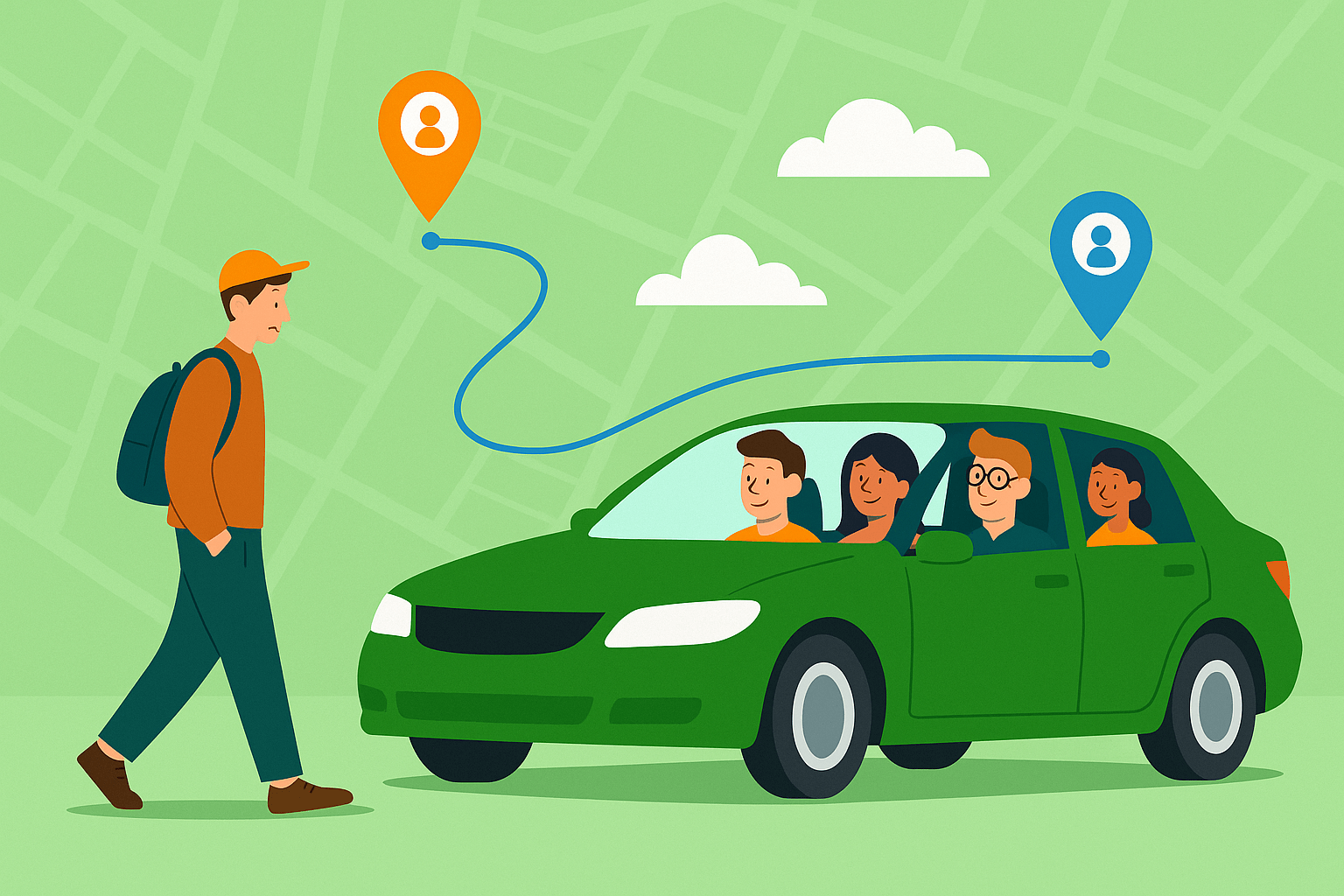
The route-matching algorithms would match those users who would travel on similar paths with each other.
- GPS-based ride tracking gives an overview of that ride in real-time.
- Also outfitted with identity and background verification systems for providing safety.
- Ratings and review mechanisms to maintain service quality.
These mechanisms lower uncertainty, which is perhaps the greatest barrier to adopting shared travel. Data shows that users are typically much more willing to share rides when the platform provides transparency, verified profiles, and predictable pricing models. Models with zero commissions do even better in attracting users since they warrant fair and non-exploitative cost-sharing.
Raising Awareness: Why Carpooling is Relevant Today
Transportation, in particular, is a sizable percentage of urban carbon emissions. Studies have shown in most cases that even a little move from solo driving to shared commuting can achieve as much as a 30-50% decrease of emissions on a per-commuter basis, depending on vehicle type and occupancy. This is the reduced emission. Beyond emissions, carpooling also translates into reductions in fuel consumption, parking demand, and traffic congestion-basic issues faced by urban planners.
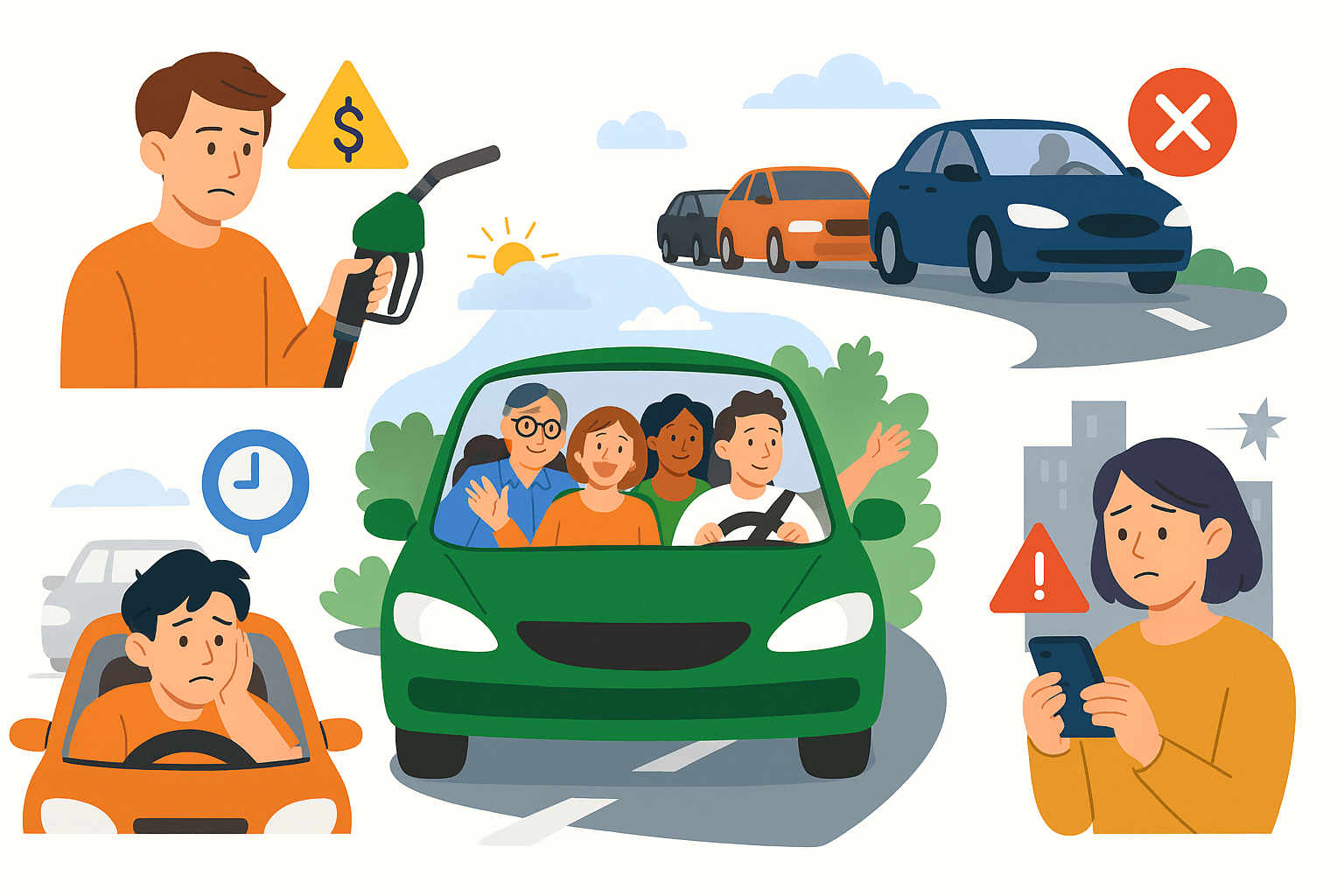
It should also be understood that a large segment of commuters still thinks about carpooling as a type of service that involves inconvenience or insecurity. Data from trends toward shared mobility adoption, however, tell another story: with reliable apps to help its users, cost-efficiency and predictability often make carpooling more financially sound and dependable than using taxis or private vehicles in regular commuting.
-
It Is Cost-Effective
Car-pooling saves money by sharing the fuel and maintenance costs for the trip. This feature is not available with traditional ride-hailing services. The best part is that in commission-free systems, users spend on the shared cost-the real-time costs.
-
Environmental Benefits
With fewer vehicles on the road, lower emissions and less fuel use go along with it. Widespread adoption of carpooling may not only get an incremental improvement in air quality but also relatively better traffic flow.
-
Proper Use of Infrastructure
Carpooling increases the effective use of the existing automobile stock, instead of adding more cars to the road. Thus, heavy pressure on roads, parking, and urban space is reduced.
-
Safety through Transparency
Identity verification, trip tracking, and mutual ratings make accountability possible. Data suggest that transparent systems bring down both ride cancellation and safety incidents.
-
Flexibility and Scalability
These modern platforms accommodate onetime and recurring rides according to real-world schedules. With that kind of flexibility, it is safe to say that carpooling can work well for students, professionals, and even the occasional traveler.
Limitations and Difficulties
No doubt, carpooling has a lot of disadvantages along with advantages.
-
Schedule dependency
To match time and route with another person, carpooling is very much dependent on neither action to take place. While algorithms definitely help make it less than alone by reducing mismatch, however, flexibility cannot run to such lengths as would either be practically impossible or awkward in the case of solo driving.
-
Threshold Adoption
For carpooling, critical mass is a must. Low density areas are limited in efficiency in matching with others.
-
Behavioral Resistance
Some commuters are resistant to share personal space or change routines to facilitate carpooling, even when it clearly makes sense according to the information.
-
Dependence on Technology
There are prerequisites for reliable internet access and some form of smartphone use, which limit accessibility to many of their populations.
Nevertheless, these challenges are increasingly alleviated with better UX design, better algorithms, and the growing public awareness for sustainability.
The Future of Connected Commuting
Carpooling represents access-based mobility rather than ownership. Movement towards smart transport systems in cities can be further enhanced by the shared mobility data, acquired through the planners in reducing congestion, improving routing, and designing more ecological urban spaces.
Analogous to this is Fella Ride: people-first technology building trust, community and environmental responsibility into everyday travel.
Conclusion
Carpooling is no longer a choice; it is now a must in modern urban ecosystems. Carpooling platforms connect many people and use technology to address economic and environmental challenges to redefine the movement of cities. This model succeeds not just through cost savings nor reduction of emissions but also on creating a smarter, more connected, and more humanistic commute.